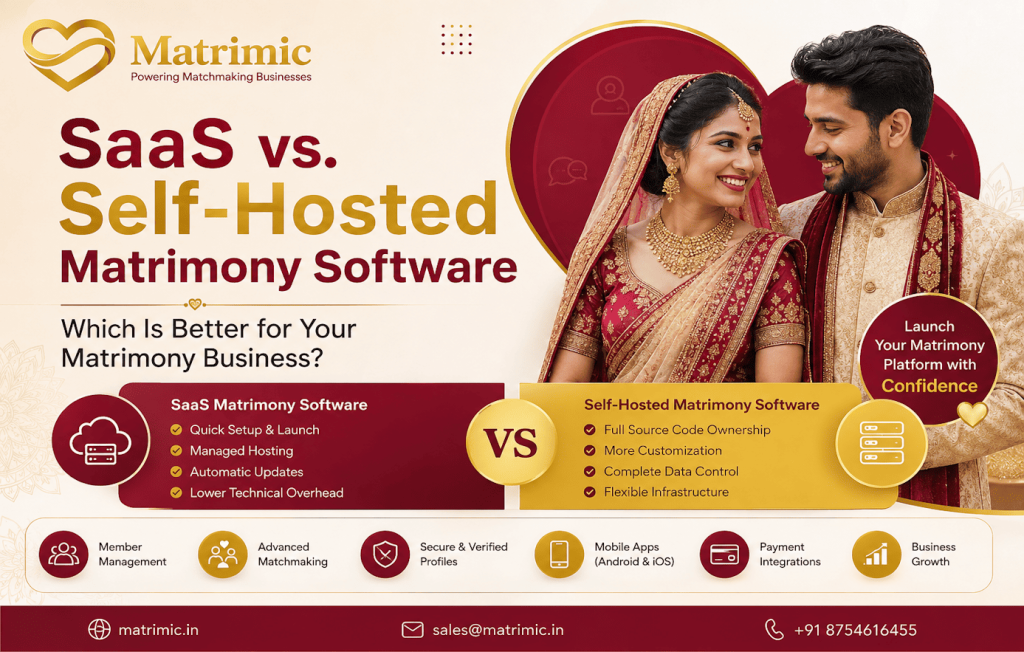
Launching a matrimonial platform is no longer simply about putting profiles on a website. Entrepreneurs and matchmaking businesses need a complete technology platform that can manage member registrations, profile verification, matchmaking, subscriptions, payments, communication, mobile apps, and business operations.
One of the most important decisions before launching is choosing between SaaS vs. Self-Hosted Matrimony Software.
Both deployment models can support a professional matchmaking business, but they offer different levels of control, responsibility, customization, infrastructure management, and long-term ownership.
For entrepreneurs building a serious matrimony business, understanding these differences can help you select the right technology strategy from the beginning.
What Is SaaS Matrimony Software?
SaaS, or Software as a Service, is a cloud-based software delivery model where the software provider hosts and manages the application and underlying infrastructure.
NIST defines SaaS as a model where customers use applications running on cloud infrastructure without managing the underlying servers, operating systems, storage, and network infrastructure.
With SaaS matrimony software, your business can generally access the platform through a web browser or mobile application while the technology provider manages hosting, infrastructure, updates, backups, and technical maintenance.
This approach is particularly attractive to entrepreneurs who want to launch quickly without building an internal technical team.
Read Also : Best Matrimonial Software for Startups | Launch Your Matchmaking Business with Matrimic
What Is Self-Hosted Matrimony Software?
Self-hosted matrimony software is deployed on infrastructure controlled by the business.
Depending on the licensing model, you may receive the source code and deploy the matrimonial platform on your own cloud server, dedicated server, or private infrastructure.
This provides greater control over:
- Server infrastructure
- Application deployment
- Database management
- Software customization
- Integrations
- Security configuration
- Data management
- Upgrade schedules
- Long-term technology strategy
The trade-off is that your business becomes more responsible for infrastructure, security, backups, deployment, monitoring, and maintenance.
AWS similarly describes on-premises deployment as requiring the organization to manage the infrastructure needed to operate the software, while SaaS shifts infrastructure management to the provider.
The Problem: Choosing the Wrong Deployment Model
Many entrepreneurs focus only on the initial software price when selecting a matrimonial platform.
That can become a problem later.
A startup may initially need a simple platform to validate its business model. However, once the number of members, staff, subscriptions, integrations, and regional requirements increases, the business may require greater customization and infrastructure control.
On the other hand, an entrepreneur who purchases a self-hosted platform without having technical resources may spend significant time managing servers and software instead of acquiring members and growing revenue.
The right question is therefore not simply:
“Which software is cheaper?”
It is:
“Which deployment model gives my business the right balance of speed, control, scalability, and operational responsibility?”
Read Also : Enterprise Matrimony Software: Build and Scale a Large-Scale Matchmaking Business with Matrimic
SaaS vs. Self-Hosted Matrimony Software: Key Differences
1. Speed of Launch
SaaS generally provides the faster route to market.
The platform is already hosted and configured, allowing entrepreneurs to focus on branding, membership plans, marketing, and customer acquisition.
Self-hosted deployment requires additional infrastructure planning, server configuration, deployment, domain setup, SSL configuration, database setup, backups, and monitoring.
For entrepreneurs trying to validate a new matchmaking business quickly, SaaS can therefore provide a significant advantage.
2. Infrastructure Management
With SaaS, infrastructure management is primarily handled by the provider.
This can include:
- Hosting
- Server monitoring
- Backups
- SSL
- Software updates
- Infrastructure maintenance
- Performance monitoring
With self-hosted software, these responsibilities generally move to the business or its technical team.
For organizations with experienced developers or system administrators, this may not be a problem. For non-technical entrepreneurs, SaaS can significantly reduce operational complexity.
3. Customization
Self-hosted matrimony software generally provides greater technical control.
Businesses can modify source code, create custom modules, integrate internal systems, and implement business-specific workflows according to their requirements.
SaaS platforms can also offer significant customization, particularly when the provider supports white-label branding, custom workflows, APIs, integrations, and feature development. However, customization remains subject to the SaaS provider’s architecture and service model.
4. Ownership and Control
This is one of the biggest differences.
A SaaS customer primarily receives access to the hosted platform.
A self-hosted solution can provide source code ownership and control over where and how the software is deployed.
For entrepreneurs planning to build a long-term technology asset, this distinction can become strategically important.
SaaS vs. Self-Hosted: Which Is Better for a Matrimony Business?
There is no universal answer.
The better option depends on your business stage and technical requirements.
SaaS Matrimony Software Is Suitable For:
- Entrepreneurs launching their first platform
- Startups validating a matchmaking business idea
- Businesses wanting faster deployment
- Organizations without an internal technical team
- Businesses that prefer managed hosting
- Agencies that want to launch multiple branded platforms
- Entrepreneurs who want predictable infrastructure management
Self-Hosted Matrimony Software Is Suitable For:
- Established matchmaking companies
- Large matrimonial agencies
- Enterprises requiring infrastructure control
- Businesses with internal development teams
- Organizations requiring extensive source-code customization
- Companies with specific compliance or infrastructure requirements
- Entrepreneurs building a long-term technology asset
Why Matrimic Supports Both SaaS and Self-Hosted Models
Matrimic Matrimony Software is designed for entrepreneurs, matchmaking agencies, marriage bureaus, community organizations, and enterprises that want to launch their own branded matrimonial platform.
The platform supports both Cloud SaaS and self-hosted deployment options, allowing businesses to select a model based on their operational requirements.
Matrimic combines a matrimonial website, Android and iOS applications, matchmaking capabilities, membership management, profile verification, communication features, payment integrations, and centralized administration.
This means entrepreneurs do not have to build every component separately.
Matrimic SaaS Matrimony Software
The managed SaaS approach is designed for businesses that want to focus on running their matchmaking operation rather than managing infrastructure.
Depending on the selected plan and implementation, the platform can include managed hosting, SSL, backups, updates, and infrastructure maintenance.
This can reduce the technical workload for a growing business.
Matrimic Self-Hosted Matrimony Software
Businesses that require greater ownership can choose a self-hosted implementation with source-code ownership.
This gives businesses more control over deployment, infrastructure, customization, integrations, and future development.
For organizations planning to build a large-scale matchmaking network, this can provide a stronger foundation for long-term technology ownership.
Important Features to Consider Before Choosing
Regardless of deployment model, entrepreneurs should evaluate the actual business capabilities of the matrimonial software.
A professional platform should support areas such as:
Member Management
Manage registration, profiles, preferences, verification, approvals, privacy controls, and member activity from a centralized dashboard.
Matchmaking
A modern matchmaking platform should provide advanced search, partner preferences, match recommendations, and configurable matchmaking rules.
Membership Monetization
Premium memberships, subscriptions, featured profiles, paid services, coupons, and other monetization options can help transform a matrimonial website into a sustainable business.
Payment Integration
The platform should support appropriate local and international payment gateways for premium memberships and other paid services.
Mobile Applications
Android and iOS applications can help increase engagement and provide members with convenient access to matchmaking services.
Multi-Language and Regional Support
Businesses targeting international markets may require multilingual interfaces, multiple currencies, Arabic RTL support, regional payment gateways, and localized workflows.
Security and Verification
Profile verification, OTP verification, privacy controls, photo protection, identity verification, admin approval workflows, and secure communication are important for building user trust.
Security should be treated as an ongoing operational responsibility, particularly when handling sensitive member information.
SaaS vs. Self-Hosted Matrimony Software: A Simple Decision Framework
Before selecting a solution, ask these questions:
Do you want to launch quickly?
Choose SaaS if minimizing infrastructure work is a priority.
Do you have an internal technical team?
Self-hosted may be more appropriate if your team can manage deployment, security, updates, and infrastructure.
Do you require extensive source-code customization?
A self-hosted solution can provide greater control.
Do you want the provider to manage hosting and maintenance?
SaaS is generally the simpler choice.
Are you building a long-term enterprise matchmaking platform?
Evaluate self-hosted source-code ownership if infrastructure and customization control are strategically important.
Why This Decision Matters for Your Matrimony Business
Your technology model affects more than deployment.
It can influence:
- Time to market
- Operating costs
- Technical staffing requirements
- Customization
- Infrastructure control
- Scalability
- Security responsibilities
- Future integrations
- Business expansion
For this reason, entrepreneurs should evaluate the complete business lifecycle rather than choosing software solely on the basis of its initial cost.
Google recommends creating helpful, people-first content and using logical internal links so users and search engines can understand related content and important pages.
For entrepreneurs researching the business side, our guide on how to start a matrimony business explains the broader process of launching and scaling a matchmaking platform. Businesses that need operational management capabilities can also explore Matrimony CRM Software.
If your business requires greater customization and ownership, explore White Label Matrimony Software to understand how a branded matrimonial website and mobile application can be deployed for an independent matchmaking business.
Final Verdict: SaaS or Self-Hosted?
The choice between SaaS vs. Self-Hosted Matrimony Software ultimately depends on your business strategy.
If your priority is speed, convenience, managed infrastructure, and reduced technical responsibility, SaaS can be the right starting point.
If your priority is source-code ownership, infrastructure control, deep customization, and long-term technology independence, self-hosted matrimony software may be the better choice.
For entrepreneurs who are uncertain, a flexible platform that supports both approaches can reduce the risk of choosing the wrong model.
Matrimic provides both options, allowing businesses to start with a managed cloud approach and, where supported by the selected implementation, transition toward greater ownership and infrastructure control as their business requirements evolve.
Launch Your Own Matrimony Platform with Matrimic
Ready to build your own matrimonial business?
Matrimic provides an enterprise-ready platform for entrepreneurs, matrimonial agencies, marriage bureaus, community organizations, and established matchmaking businesses.
Launch with your own branding, domain, website, Android and iOS applications, matchmaking engine, membership plans, profile verification, payment integrations, and centralized admin dashboard.
Request a Matrimic demo and discuss whether SaaS or self-hosted deployment is the right fit for your business.
Explore Matrimic Matrimony Software
Frequently Asked Questions
1. What is the difference between SaaS and self-hosted matrimony software?
SaaS matrimony software is hosted and maintained by the software provider, while self-hosted software is deployed on infrastructure controlled by the business. SaaS reduces infrastructure responsibility, while self-hosted deployment provides greater control.
2. Is SaaS matrimony software better for startups?
SaaS can be a strong option for startups because it can reduce deployment complexity and allow entrepreneurs to focus on branding, marketing, member acquisition, and business development rather than server management.
3. Is self-hosted matrimony software better for enterprises?
It can be, particularly when an enterprise requires source-code ownership, extensive customization, infrastructure control, custom integrations, or an internal technical team capable of managing the platform.
4. Can I customize SaaS matrimony software?
Customization depends on the provider and platform architecture. Matrimic supports white-label branding and can provide customization and integration services based on the selected implementation.
5. Does Matrimic offer both SaaS and self-hosted matrimony software?
Yes. Matrimic provides managed Cloud SaaS options as well as self-hosted lifetime source-code licensing options, allowing businesses to choose an approach based on their operational and ownership requirements.
6. Can I move from SaaS to self-hosted later?
Matrimic states that existing SaaS customers can upgrade to a self-hosted lifetime license, with data migration and deployment assistance available depending on the implementation. This provides a potential path for businesses that start with SaaS and later require greater control.
Author
Matrimic Team
Matrimic Team creates practical resources for entrepreneurs, matchmaking businesses, matrimonial agencies, marriage bureaus, community organizations, and enterprises looking to build and scale professional matrimonial platforms.