Wedding Vendor Marketplace Software Explained: Features, Benefits & Business Opportunities
The wedding industry is no longer driven only by offline referrals and traditional wedding directories. Couples increasingly use digital platforms to discover wedding venues, photographers, caterers, decorators, makeup artists, planners, and other professionals before making a booking decision.
For entrepreneurs, this creates a major opportunity: build a wedding vendor marketplace that connects couples with trusted wedding businesses while generating revenue through subscriptions, featured listings, leads, bookings, or advertising.
This is where wedding vendor marketplace software becomes important.
A modern wedding marketplace gives businesses the technology required to manage vendors, categories, profiles, searches, inquiries, memberships, reviews, payments, and customer interactions from one centralized platform.
For entrepreneurs considering a platform similar to WeddingWire or another wedding marketplace, the objective should not simply be to copy an existing website. The goal is to create a branded marketplace designed around a specific country, city, community, wedding segment, or business model.
What Is Wedding Vendor Marketplace Software?
Wedding vendor marketplace software is a technology platform that connects couples searching for wedding services with businesses offering those services.
Instead of requiring users to search dozens of individual websites, a marketplace brings wedding professionals together under one platform.
Typical vendor categories can include:
- Wedding venues
- Photographers
- Videographers
- Wedding planners
- Caterers
- Florists
- Decorators
- Makeup artists
- DJs and musicians
- Wedding dress designers
- Cake designers
- Jewelry businesses
- Invitation providers
- Transportation companies
- Event rental businesses
The platform allows vendors to create business profiles and allows couples to discover, compare, contact, and potentially book those vendors.
For an entrepreneur, the platform becomes more than a directory. It can become a two-sided wedding marketplace business.
The Problem Wedding Businesses and Couples Face
Before building a marketplace, entrepreneurs need to understand the problems it solves.
1. Wedding Vendors Are Scattered Across Multiple Channels
A couple may discover one photographer through Instagram, a venue through Google, a decorator through a recommendation, and a caterer through another local directory.
This fragmented discovery process makes wedding planning unnecessarily complicated.
A centralized wedding vendor marketplace can organize these businesses into categories and locations so customers can discover relevant services more efficiently.
2. Customers Struggle to Compare Vendors
Finding a vendor is only the first step.
Customers also want to know:
- What services are offered?
- Where is the vendor located?
- What is the approximate price?
- What does their portfolio look like?
- What do previous customers say?
- Is the vendor available on the required date?
Vendor profiles, portfolios, reviews, packages, and inquiry tools can make the decision-making process easier.
3. Vendors Need Consistent Lead Generation
Wedding professionals need customers, not just website traffic.
A marketplace can generate business inquiries by allowing couples to submit their requirements and connect with relevant vendors.
For example, a customer could submit:
“I need a wedding photographer and decorator for a 300-person wedding in Dubai.”
The platform can route the inquiry to suitable vendors.
This creates measurable business value for vendors and gives the marketplace owner opportunities to monetize qualified leads.
4. Traditional Wedding Directories Have Limited Business Models
A simple directory may generate revenue from advertising, but a sophisticated marketplace can create multiple revenue streams.
This can include vendor subscriptions, featured listings, premium profiles, lead packages, advertising, booking fees, and promotional campaigns.
How Does a Wedding Vendor Marketplace Work?
A typical marketplace has three primary participants:
Customers
Couples search for wedding services, view vendors, compare options, submit inquiries, communicate with businesses, and potentially make bookings.
Vendors
Wedding professionals create profiles, upload portfolios, manage services, receive inquiries, respond to leads, and purchase premium marketplace plans.
Marketplace Owner
The platform owner manages categories, vendors, customers, subscriptions, payments, reviews, promotions, content, and overall marketplace operations.
This structure creates a scalable ecosystem where more vendors increase customer choice and more customer traffic increases the value of the platform for vendors.
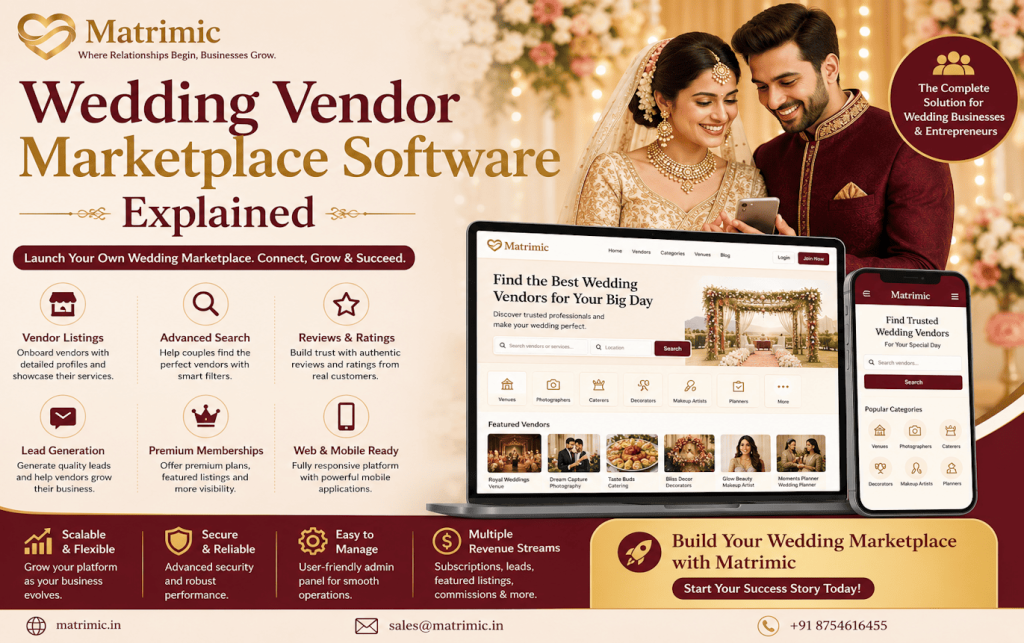
Essential Features of Wedding Vendor Marketplace Software
A professional platform should include more than vendor listings.
Vendor Registration and Profiles
Vendors should be able to create detailed profiles containing:
- Business name
- Category
- Location
- Description
- Portfolio
- Services
- Packages
- Pricing
- Contact options
- Availability
- Reviews
- Promotional offers
Advanced Search and Filters
Customers should be able to search vendors based on location, category, price range, rating, services, and other relevant criteria.
Location-based search is particularly important for local wedding marketplaces.
Reviews and Ratings
Trust is one of the most important factors in wedding services.
A review system allows customers to share experiences and helps potential customers evaluate vendors before making contact.
Lead and Inquiry Management
The marketplace should allow customers to send inquiries while vendors can receive and manage those leads from their dashboards.
Membership and Subscription Management
The marketplace owner can offer different vendor packages, such as:
Basic: Business listing and profile
Professional: Enhanced profile, portfolio, and additional visibility
Premium: Featured placement, promotional tools, analytics, and higher marketplace exposure
Featured Vendor Listings
Premium vendors can be highlighted within category pages, location pages, search results, or promotional sections.
Payment Integration
If your marketplace accepts vendor subscriptions, booking payments, deposits, or commissions, secure payment infrastructure becomes an important component.
Marketplace payment systems can involve multiple parties and require careful handling of onboarding, payment routing, payouts, refunds, and compliance. Stripe’s marketplace documentation provides an overview of these workflows. (Stripe Docs)
Web and Mobile Applications
A responsive website is essential, but mobile applications can provide an additional channel for customers and vendors.
A scalable platform can support web, Android, and iOS experiences depending on the business model.
How Matrimic Can Help Build Your Wedding Marketplace
Matrimic is primarily positioned as a matrimony and matchmaking software platform, but its technology foundation can also be customized for entrepreneurs who want to develop adjacent relationship, wedding, vendor, and marketplace business models.
The advantage is that entrepreneurs do not necessarily have to build every foundational component from zero.
Matrimic Matrimony Script provides a ready technology foundation with website and mobile applications, profile management, search, memberships, communication, payment integration, administration, and customization capabilities.
For a wedding vendor marketplace project, the existing foundation can be adapted around the required vendor workflows, categories, customer discovery, inquiry management, marketplace monetization, and branding.
Businesses looking for larger-scale technology can also review Matrimic Enterprise Matrimony Software, which is positioned for entrepreneurs and large matchmaking businesses requiring advanced administration, scalability, memberships, verification, and customization.
Why Choose a Ready Technology Foundation?
Building a complete marketplace from scratch can require substantial development time.
You need to design:
- Customer registration
- Vendor registration
- Authentication
- Admin management
- Search
- Profiles
- Memberships
- Payment integration
- Notifications
- Reviews
- Mobile applications
- Security
- Reporting
- Content management
A ready platform foundation can reduce the amount of foundational development required and allow the entrepreneur to focus more heavily on business growth.
This is especially valuable for startups that want to validate a marketplace concept before investing in a completely custom technology stack.
Business Models for a Wedding Vendor Marketplace
A wedding marketplace can generate revenue in several ways.
Vendor Subscription Plans
Charge wedding professionals recurring fees for premium access and enhanced visibility.
Featured Listings
Vendors can pay to appear prominently within relevant categories or locations.
Lead Generation
Charge vendors for qualified customer inquiries or lead packages.
Booking Commission
The platform can potentially earn a percentage from transactions completed through the marketplace.
Advertising
Wedding brands can advertise products and services to customers already searching for wedding solutions.
Premium Vendor Promotion
Create additional paid promotional opportunities for vendors during seasonal campaigns, wedding seasons, or special events.
The correct model depends on your target market and the value your marketplace provides.
Why a Wedding Vendor Marketplace Is Important for Entrepreneurs
The opportunity is not simply to create another directory.
A well-designed marketplace can become the digital infrastructure connecting an entire wedding ecosystem.
Entrepreneurs can target specific niches such as:
- Luxury weddings
- Destination weddings
- Indian weddings
- South Asian weddings
- Muslim weddings
- African weddings
- GCC wedding services
- Regional wedding businesses
- Wedding venues
- Wedding photography
- Complete wedding planning
This niche-first strategy can help a new marketplace differentiate itself from larger general-purpose platforms.
SEO Is Important for Wedding Marketplace Growth
Technology alone does not guarantee marketplace traffic.
Your website should also be structured around search intent.
For example, you can create pages targeting searches such as:
- Wedding vendors in Dubai
- Wedding photographers in Toronto
- Wedding venues in London
- Wedding planners in New York
- Wedding decorators in Mumbai
- Best wedding vendors in Saudi Arabia
You can also publish educational content around wedding planning, vendor selection, pricing, venues, photography, and event management.
Google recommends creating helpful, people-first content and using descriptive titles, URLs, and relevant links to help users and search engines understand a website. (Google for Developers)
Internal linking should also connect related category, location, service, and blog pages. Google specifically recommends relevant internal links and descriptive anchor text to help users and search engines discover important pages. (Google for Developers)
For additional Matrimic resources, businesses can explore Matrimic Features, Matrimic Pricing, and Enterprise Matrimony Software.
Advantages of Wedding Vendor Marketplace Software
Faster Market Entry
A ready technology foundation can help reduce the time required to build core marketplace functionality.
Better Vendor Management
Centralized vendor dashboards make it easier to manage profiles, services, listings, memberships, and inquiries.
Multiple Revenue Opportunities
Subscriptions, featured listings, leads, commissions, and advertising can create diversified revenue streams.
Stronger Customer Experience
Customers can discover multiple wedding services from one platform instead of searching across numerous websites.
Scalable Business Model
Once a marketplace gains traction in one city or country, the model can potentially expand into additional locations and categories.
Complete Brand Ownership
With a branded platform, entrepreneurs control the domain, branding, customer experience, pricing strategy, vendor relationships, and business direction.
What Should Entrepreneurs Consider Before Launching?
Before investing in development, define your marketplace strategy.
Ask:
- Which country or city will you target?
- Which wedding categories will launch first?
- Will vendors pay subscriptions or lead fees?
- Will customers book directly through the platform?
- Will you offer mobile applications?
- How will vendors be verified?
- How will reviews be moderated?
- How will you acquire the first 100 vendors?
- What SEO strategy will generate customer traffic?
- How will you scale after proving product-market fit?
A clear business model should come before adding unnecessary features.
Build Your Wedding Vendor Marketplace with Matrimic
The future of wedding discovery is increasingly digital, creating opportunities for entrepreneurs to build specialized marketplaces that connect couples with trusted wedding professionals.
Wedding vendor marketplace software gives you the foundation to organize vendors, generate leads, manage memberships, support customer discovery, and create multiple business revenue streams.
Matrimic can provide the underlying technology foundation and customization required to turn your marketplace concept into a branded digital platform.
Whether you want to build a local wedding vendor directory, a regional marketplace, a destination wedding platform, or a broader wedding services ecosystem, the right technology can help you move from idea to launch faster.
Ready to Launch Your Wedding Marketplace?
Build your own branded wedding marketplace with Matrimic and create a platform designed around your target market, vendors, customers, and revenue model.
Contact the Matrimic Team to discuss your requirements, customization needs, website, mobile applications, marketplace workflows, and launch strategy.
Frequently Asked Questions
1. What is wedding vendor marketplace software?
Wedding vendor marketplace software is a platform that connects couples with wedding service providers such as photographers, venues, planners, caterers, decorators, and makeup artists. It typically includes vendor profiles, search, inquiries, reviews, memberships, payments, and administration tools.
2. Can I build a wedding marketplace like WeddingWire?
Yes. A wedding marketplace can be developed with vendor listings, location-based search, reviews, lead generation, premium listings, subscriptions, payments, and mobile applications. The platform can then be customized around your brand and target market.
3. Can Matrimic be customized for a wedding vendor marketplace?
Yes. Matrimic is primarily a matrimony and matchmaking technology platform, but its technology foundation can be customized for related wedding and marketplace requirements depending on the project’s scope, workflows, and features.
4. How does a wedding vendor marketplace make money?
Common revenue models include vendor subscriptions, featured listings, lead generation, booking commissions, advertising, premium profiles, and promotional packages.
5. Do I need a mobile app for my wedding marketplace?
A mobile app is not mandatory for the initial launch, but Android and iOS applications can provide an additional customer and vendor channel as the marketplace grows. The appropriate approach depends on your target audience and business strategy.
6. How can I attract vendors to a new wedding marketplace?
Start with a focused geographic or service niche, offer strong vendor profiles, create valuable customer leads, develop local partnerships, use SEO-driven category and location pages, and provide vendors with measurable business value.
Author
Matrimic Team
Matrimic Team specializes in matrimonial software, matchmaking platforms, white-label solutions, mobile applications, and customized technology platforms for entrepreneurs and businesses worldwide.